
The IDAEA’s Environmental Geochemistry and Atmospheric Research group participates in the AeroSolfd project, which addresses the challenge of improving poor air quality in urban areas due to emissions of harmful particles from road transport, especially those due to exhaust pipes and brake use.
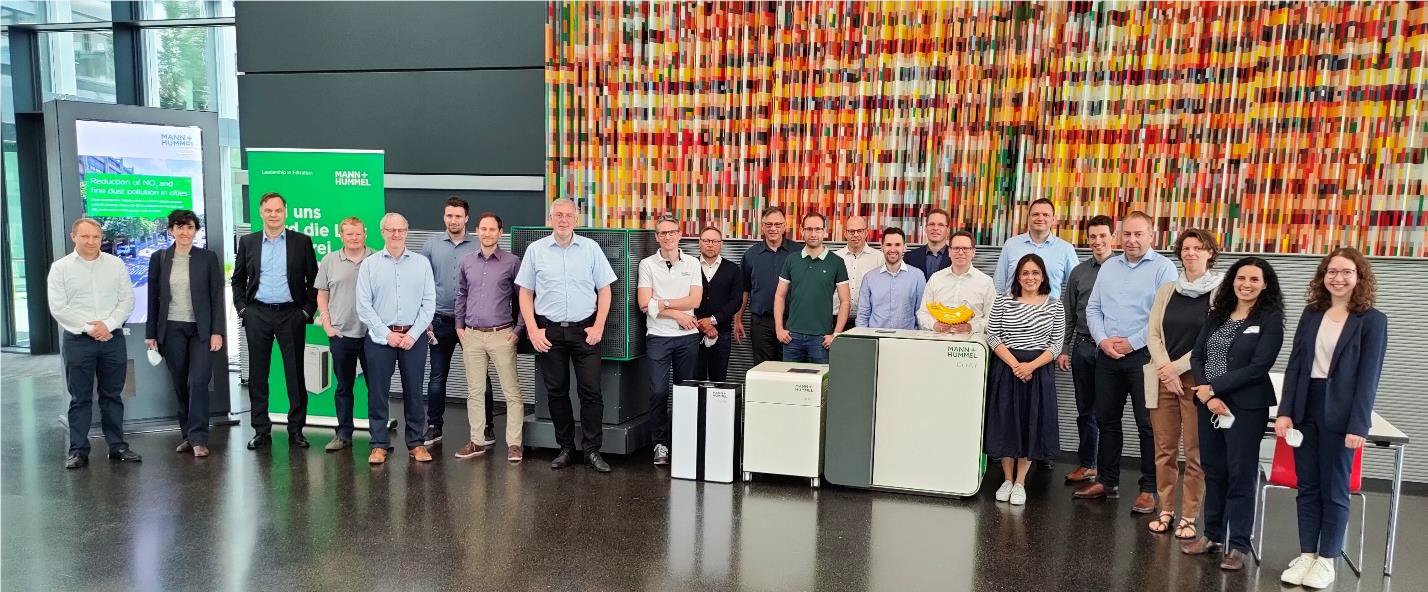
IDAEA’s director Teresa Moreno attended the kick-off meeting in the Technology Centre of project coordinator MANN+HUMMEL in Ludwigsburg, Germany.
The project consortium, led by MANN+HUMMEL and composed of large industrial players, renowned scientific institutes, and lighthouse demo sites from 8 European countries, will carry out a rapid deployment of three low-cost adaptable solutions for gasoline vehicle exhaust pipes, bus brakes, and for air purification in closed and semi-closed spaces. With these solutions, citizens of Europe and other countries will be able to benefit from cleaner mobility and a healthier environment as early as 2025.
“Retrofits are key enabling technologies during the transition to zero-exhaust vehicles by electrification and until reduced non-exhaust measures are implemented. Even beyond, brake and closed environment retrofits will continue to play an important role in the electrified road and rail fleet”, explained Dr. Martin Lehmann, coordinator of the AeroSolfd project.
In gasoline combustion engines, fine particles and toxic secondary emissions will be reduced by an innovative Gasoline Particle Filter and NOx exhaust emissions would be minimised by replacing the three-way-catalyst with new equipment. In addition, brake particles of long-lived road transport assets will be reduced by an advanced brake dust particle filter and fine particles in closed environments (bus stops, tunnels, metro stations) using a specially designed and enhanced stationary air purifier.
More information on this link.