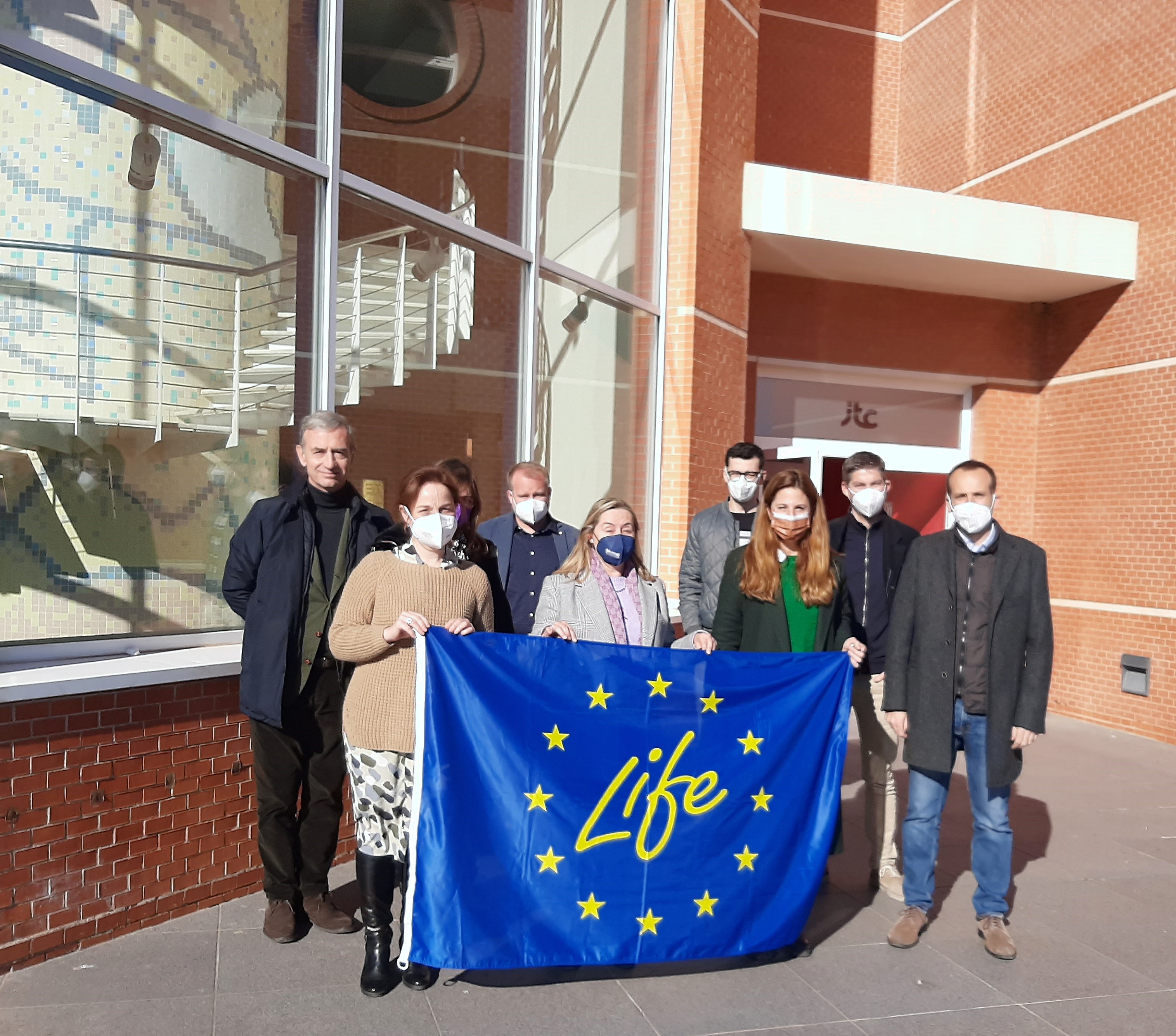

The researcher Mar Viana, together with lab technicians Mercè Cabañas, Verónica Moreno, and Rafael Bartrolí, from the Environmental Geochemistry and Atmospheric Research (EGAR) group participate in the European project LIFE NANOHEALTH, whose kick-off meeting was held on January 26. Funded by the LIFE Environment and Resource Efficiency Program of the European Commission, and coordinated by the Institute of Ceramic Technology (ITC-AICE), NANOHEALTH’s objective is to improve the occupational health of employees working in industrial environments who are exposed to nanoparticles.
Certain industry jobs are exposed to significant concentrations of nanoparticles from several highly energetic sources, some of them not even studied, which can have a negative impact on health. For this reason, LIFE NANOHEALTH carries out experimental measures in order to support the evaluation of health risks and to reduce occupational exposure to nanoparticles in industrial environments.
“We will characterize the exposure to nanoparticles in industrial plants before and after implementing the purification systems, to evaluate their effectiveness. Our data will also be used to validate the indoor dispersion model that the UPC will develop soon”, explains the IDAEA researcher Mar Viana.
Among the project’s actions is the construction of an air purifier, the NANOHEALTH PURIFIER, for industrial environments, which aims to function under real operating conditions and will allow microenvironments to be achieved with an emission reduction efficiency of at least 90% of nanoparticles. In addition, the NANOHEALTH TOOL will be designed, which will allow selecting a set of corrective measures for industrial work environments to minimize the exposure by at least 75%. Finally, the NANOHEALTH SERVICE service will be designed, which will be applied in 7 industrial plants to verify its efficiency and validity.
More information about the project: LIFE NANOHEALTH