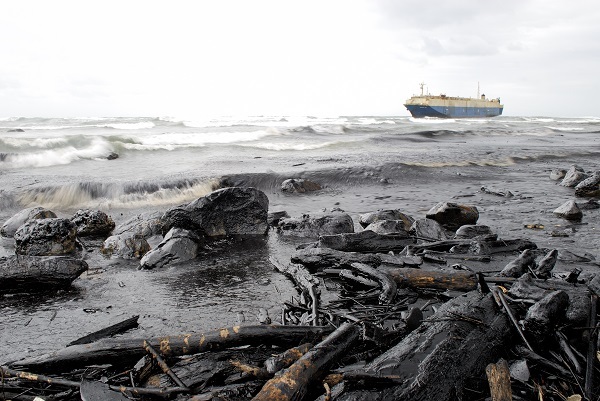

Researchers of the Complutense University of Madrid (UCM) in collaboration with the Institute of Environmental Assessment and Water Research (IDAEA-CSIC) and the National Autonomous University of Mexico (UNAM) have developed software based on a mathematical model that simulates the oil spill movements offshore in order to reduce its environmental impact. The Software for Oil Spill Movement and Removal (SOSMAR) takes into account the main physical and chemical processes that take place in the spilled oil over time, such as evaporation, emulsion, and dispersión.
Dr. Jesús Carrera, from the group Groundwater and Hydrogeochemistry group, has collaborated in this research by showing how this mathematical model could be used to analyze the compositional formulation, considering these spills as continuous bodies, rather than sets of particles, and their aging process.
“The mixing processes within the spill are quite important because the oil is “aging”: the volatile fraction passes into the air and the most soluble one dissolves in the sea, so the fraction that remains is the thickest. This “aging” process is more pronounced at the edges, so the swell makes the edges blend in with the center.”, explains Carrera.
The researchers have tested the software in real disasters, such as the one produced by the Russian fishing vessel in the Canary Islands in 2015 or the Italian container ship on the French coasts in 2019, with successful results.