



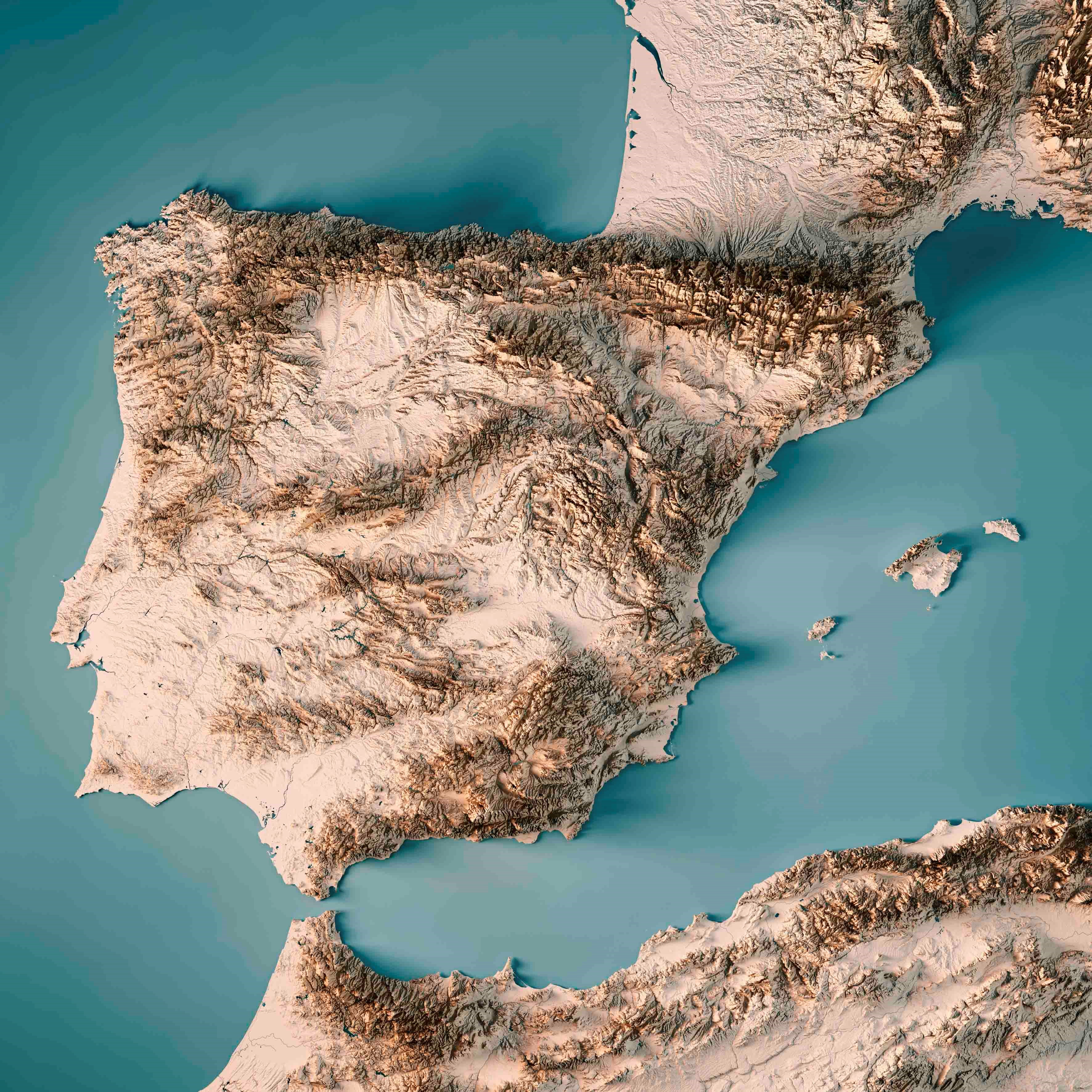
Iberian peninsula | iStock
The oldest known hominin remains in Europe come from the Iberian Peninsula and suggest that the first archaic humans arrived from southwest Asia 1.4 million years ago. The climate at this early Pleistocene period was characterized by warm, humid interglacial periods and mild glacial periods, so it has long been assumed that, once the first humans arrived, they were able to survive in southern Europe through multiple climatic cycles and adapt to increasingly cold conditions of the last 900,000 years.
However, a study carried out by an international team led by researchers from University College London (UCL), the Institute for Environmental Assessment and Water Research (IDAEA-CSIC), and the South Korean IBS Center for Climate Physics and published yesterday in Science has discovered the occurrence of unknown extreme glacial conditions around 1.12 million years ago. “This challenges the idea of an early and permanent human occupation of Europe”, says UCL professor Chronis Tzedakis.
A team of paleoclimatologists from UCL, the University of Cambridge, and IDAEA-CSIC reconstructed the conditions of a marine sedimentary core sampled off the coast of Portugal, which has shown the presence of abrupt climate changes that culminated in extreme glacial cooling ago 1.12 million years.
“To our surprise, we discovered that the cooling was comparable to the most extreme events of the recent ice ages,” says the IDAEA-CSIC researcher Joan O. Grimalt.
This would have subjected the small bands of hunter-gatherers to considerable stress, “particularly as early humans may have lacked adaptations such as sufficient insulation from fat, as well as effective clothing, shelter, or knowledge of fire-making,” according to the researcher Vasiliki Margari.
Nota de prensa (ESP)
Nota de premsa (CAT)
Vasiliki Margari, David A. Hodell, Simon A. Parfitt, Nick M. Ashton, Joan O. Grimalt, Hyuna Kim, Kyung-Sook Yun, Philip L. Gibbard, Chris B. Stringer, Axel Timmermann, Polychronis C. Tzedakis. (2023) Extreme glacial implies discontinuity of early hominin occupation of Europe. Science, 381 (6658). DOI: 10.1126/science.adf4445
Iberian peninsula | iStock