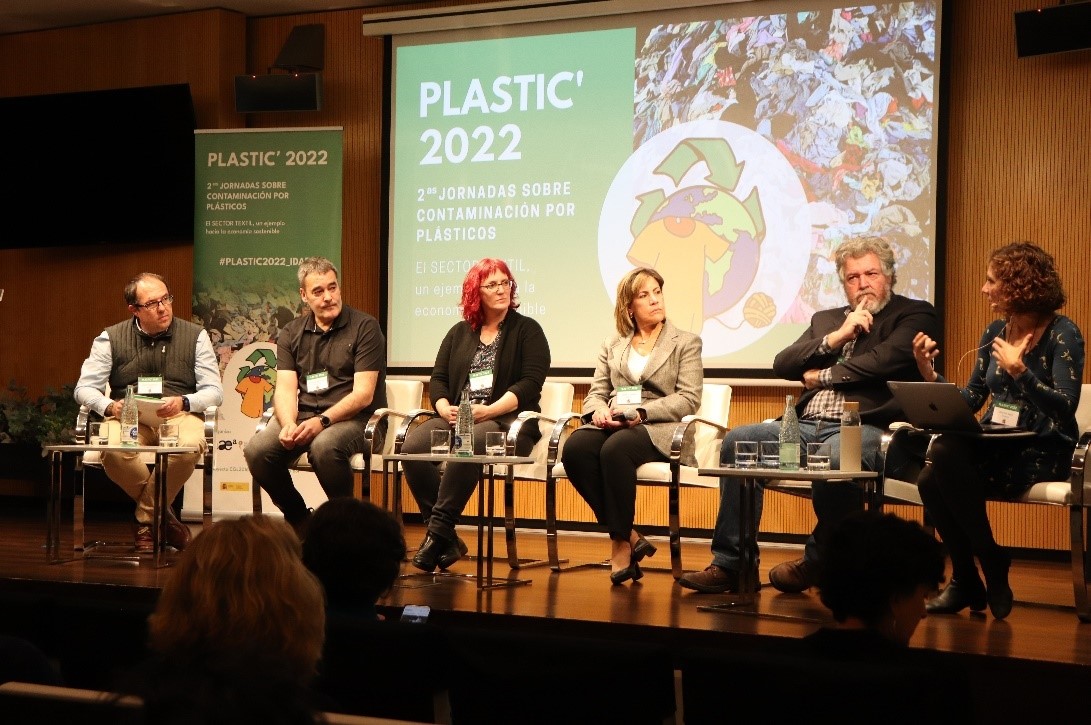

From left to right: Igor González (Ecotextil), Eduardo Uribesalgo (Ternua Group), Rosa García (Rezero), Ethel Eljarrat (IDAEA-CSIC), Juan López de Uralde (Spanish Parliament) and Cristina Sáez (journalist). Source: Alejandro Rodríguez.
The 2nd Conference on Plastic Pollution PLASTIC’2022 (2as Jornadas de Contaminación por Plásticos PLASTIC’2022), organised by the Institute for Environmental Assessment and Water Research (IDAEA-CSIC), took place on November 21 and 22 at CaixaForum Macaya.
More than a hundred people attended this second edition, which was focused on plastic pollution in the textile and clothing sector. Experts from academia, the fashion industry, waste management, and public administration addressed the current initiatives to minimize the impact of plastic pollution in this sector.
The textile industry is responsible for between 5 and 10% of CO2 emissions and 20% of polluted water worldwide.
“It is estimated that half a million tons of microplastic fibers are released into the marine environment every year,” explained Ethel Eljarrat, coordinator of the conference and researcher at IDAEA-CSIC, who also explained the problem of chemical additives in plastics and the human exposure to these compounds.
One of the key points during the conference was the reduction in the consumption of fashion items. Rosa García (director of Rezero) and Gemma Gómez (director of Slow Fashion Next) addressed the consequences of fast fashion, a trend that generates between 35 and 95 million tons of textile waste every year, of which only 1% is recycled.
Joan Santamaría, from Hilaturas Arnau, and Eduardo Uribesalgo, from Ternua Group, explained different strategies for manufacturing garments using sustainable and ecological fabrics. Currently, polyester is the main raw material of textiles and synthetic fiber materials, and comes from fossil fuels.
Juan López de Uralde, president of the Commission for Ecological Transition and Demographic Challenge and member of the Spanish Parliament, also participated in talking about the measures contemplated in the new Waste Law to stop plastic pollution.
The event finished with a round table moderated by Cristina Sáez, a science, environment and health journalist. The debate began by outlining the challenges that the textile industry has to face in order to minimize the impact of plastic pollution and reduce consumption from the business, scientific and legislative spheres. The speakers concluded that consumers need to be aware of the consequences of fast fashion to seek more sustainable consumption alternatives, with better quality garments, and avoid increasing textile waste.