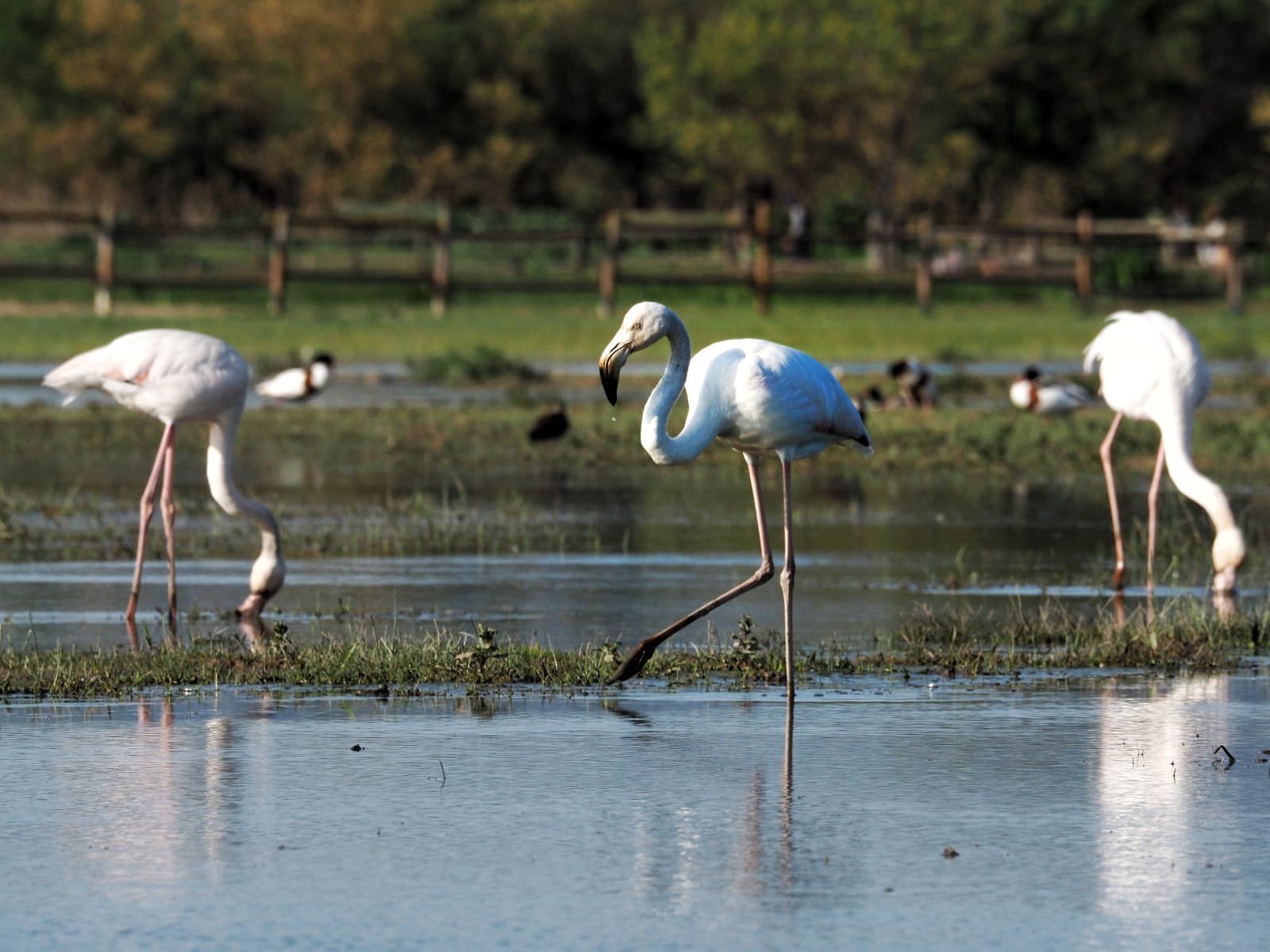

Flamingo chicks from the Ebro Delta are exposed to multiple contaminants from a very early age. | Source: Maria Dulsat
A new study led by IDAEA researchers Maria Dulsat-Masvidal and Sílvia Lacorte from the Chemometrics group, reveals that flamingos in the Ebro Delta are exposed to a wide variety of micropollutants from an early age, which shows the importance of pollution as a threat to the conservation of waterfowl. The study highlights the need to include biomonitoring studies to assess the impact of environmental pollution on biodiversity conservation.
“Despite the fact that the Ebro Delta Natural Park is considered internationally one of the most important natural spaces for the conservation of biodiversity in Europe, it is facing several environmental pressures that, in many cases, constitute a source of chemical contamination for their ecosystems”, declares the IDAEA researcher Sílvia Lacorte, principal author of the study.
One of the most emblematic aquatic birds of the Ebro Delta wetlands is the flamingo (Phoenicopterus roseus), a wading bird whose survival is closely linked to the health of the wetlands. The Ebro Delta flamingo colony is one of the few stable ones in the Western Mediterranean, perhaps because it is more or less “safe” from the influence of tourism and invasive species. However, very little is known about the potential impact of the chemical contamination that threatens the Ebro Delta wetlands could have on the conservation of the species.

The flamingo breeding colony from the Ebro Delta is ringed annually. This activity was used to capture two-month-old flamingo chicks and take blood samples from 50 individuals. | Source: Sílvia Lacorte
Scientists from the IDAEA – CSIC and the Instituto de Investigación en Recursos Cinegéticos (IREC – CSIC, UCLM, JCCM), in collaboration with the Associació Ornitològica Picampall de les Terres de l’Ebre, have analysed for the first time the exposure of flamingo chicks from the Ebro Delta to chemical contaminants.
“We analysed several chemical pollutant families, including organochlorine pesticides, polychlorinated biphenyls, polycyclic aromatic hydrocarbons, perfluoroalkyl substances, pharmaceuticals, organophosphate esters, and pesticides in current use, with the objective of evaluating the exposure of this waterfowl to emerging and inherited contaminants and the potential risks for its survival”
The results showed that flamingo chicks from the Ebro Delta are exposed to multiple contaminants from a very early age, indicating exposure to persistent compounds and polycyclic aromatic hydrocarbons (PAHs). The total concentration of contaminants ranged from 16.9 to 623 ng/mL, and according to the average concentration followed the order perfluoroalkyl substances (PFAS) > polycyclic aromatic hydrocarbons (PAH) > organochlorine pesticides > polychlorinated biphenyls (PCBs). No residues of drugs, organophosphate esters (OPE), or pesticides in current use were detected. Egg transfer and ingestion via filtration of benthic organisms are the most likely routes of exposure to contaminants in flamingo chicks.
Perfluoroalkyl substances (PFAS) were the most ubiquitous contaminants and those detected at the highest concentrations, highlighting PFOA (3.04–366 ng/mL), PFOS (3.83–35.6 ng/mL) and PFHxS (1.80–39 ng/mL) for having been detected in all sampled flamingos. The compound detected at the highest concentration was PFOA, detected at levels higher than those described in marine predators and birds of prey. There are multiple sources of PFAS in the environment that could cause flamingos to be exposed to these compounds, including discharges from sewage treatment plants, sewage sludge, landfills, and the application of fire-fighting foams.

Blood samples were analyzed using liquid and gas chromatography techniques coupled with high-resolution tandem mass spectrometry. | Source: Rafael Mateo
7 of the 16 PAHs were detected in 90% of the individuals. Naphthalene was detected in 84% of the samples, representing 41% of the total sum of PAHs, followed by pyrene with an occurrence in 64% of the samples and contributing to 47% of the total sum of PAHs. The high prevalence of naphthalene and pyrene would point to both a petrogenic and a pyrogenic source associated with the fires that occurred in the area.
Organochlorine pesticides and PCBs showed high ubiquity in the samples. The metabolite of the organochlorine pesticide DDT, 4-4’DDE, was detected in 90% of the individuals, and PCB 153 in 46%. However, the levels detected are considered low and comparable to those that have been described in other birds in the area, which is why it is attributed to the historical use of these compounds.
In principle, these levels of exposure to chemical contamination were not associated with alterations in the body mass of the flamingos or their development indices, although more studies are needed to understand possible effects at the molecular level.
Dulsat-Masvidal, M., Bertolero, A., Mateo, R., Lacorte, S. 2022. Legacy and emerging contaminants in flamingos’ chicks’ blood from the Ebro Delta Natural Park. Chemosphere 312 (Part 1), 137205.