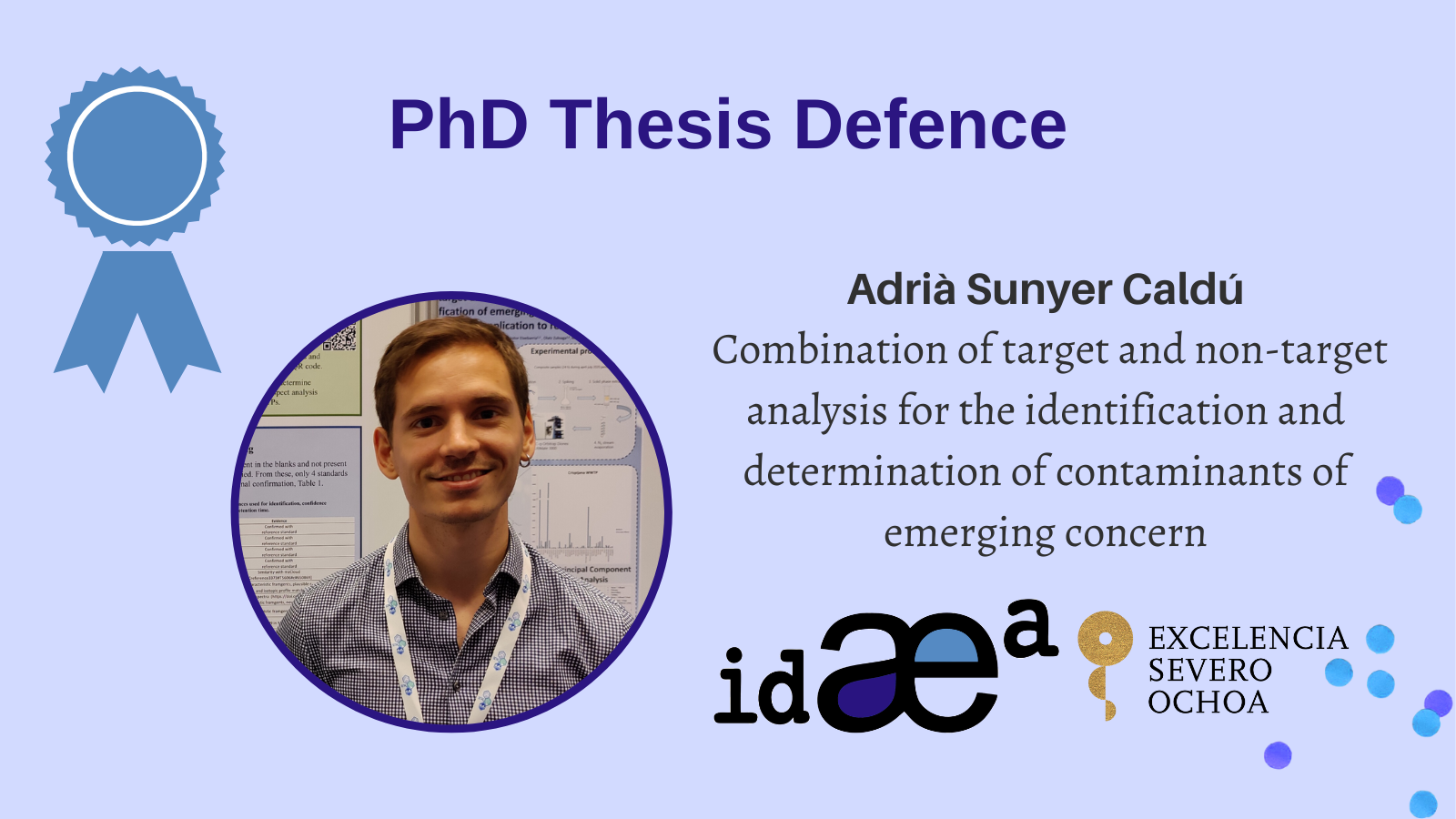
The PhD student Adrià Sunyer Caldú from the ENFOCHEM group will defend his thesis titled "Combination of target and non-target analysis for the identification and determination of contaminants of emerging concern"
The PhD student Adrià Sunyer Caldú, from the ENFOCHEM group, will defend his thesis on 13 January at 11:30h in the Aula Enric Casassas of the Faculty of Chemistry at the Universitat de Barcelona.
Title: Combination of target and non-target analysis for the identification and determination of contaminants of emerging concern
Directors: Silvia Diaz Cruz and Pablo Gago Ferrero
Thesis Committee: Víctor Matamoros, Lubertus Bijlsma and Jana Weiss
Abstract:
Contaminants of emerging concern (CECs) are those that have been detected in the environment and/or in humans, can cause ecological or human health impacts, and are normally not regulated. Their continuous introduction into the environment (favoured by conventional wastewater treatments’ inefficiency in their degradation), pseudo-persistence, and intrinsic ability to interfere with organisms, concern the scientific and public community. Their potential toxic effects can threaten the ecological status of water bodies as well as human health. There is a need to know what these contaminants are and understand their occurrence, fate and transformation processes in the environment. In the current context of climate change, circular economy processes acquire great importance. In this regard, the reuse of waste and reclaimed water is applied as a helpful solution to alleviate water scarcity and enable better use of resources. However, this approach is not exempt from risk, since the water-borne contaminants can be translocated into crops after irrigation, constituting a threat to human health. Likewise, there are other routes of exposure to CECs that should be studied, and human biomonitoring is necessary to address specific exposures. In this thesis, powerful analytical methodologies were developed and applied in the different stages of the CECs cycle, from their release until they are degraded (transformed) or (bio)accumulated. The presence of different types of CECs including personal care products (PCPs), pharmaceuticals, biocides and per- and polyfluoroalkyl substances (PFAS) was assessed in different environmental compartments. Advanced target and non-target approaches were applied to expand the knowledge of the presence of these chemicals and their derived transformation products in water, sediment, biota, and crops. Special emphasis was placed on evaluating the wastewater reuse feasibility for irrigation purposes in agriculture. Finally, human exposure to CECs was evaluated, putting a special focus on prenatal exposure at the early stage of development through the analysis of umbilical cord blood. Thus, this thesis has contributed to improving the understanding and knowledge about CECs occurrence, removal, transformation, transfer, and fate in aquatic ecosystems, agrifood environment and, ultimately, humans.