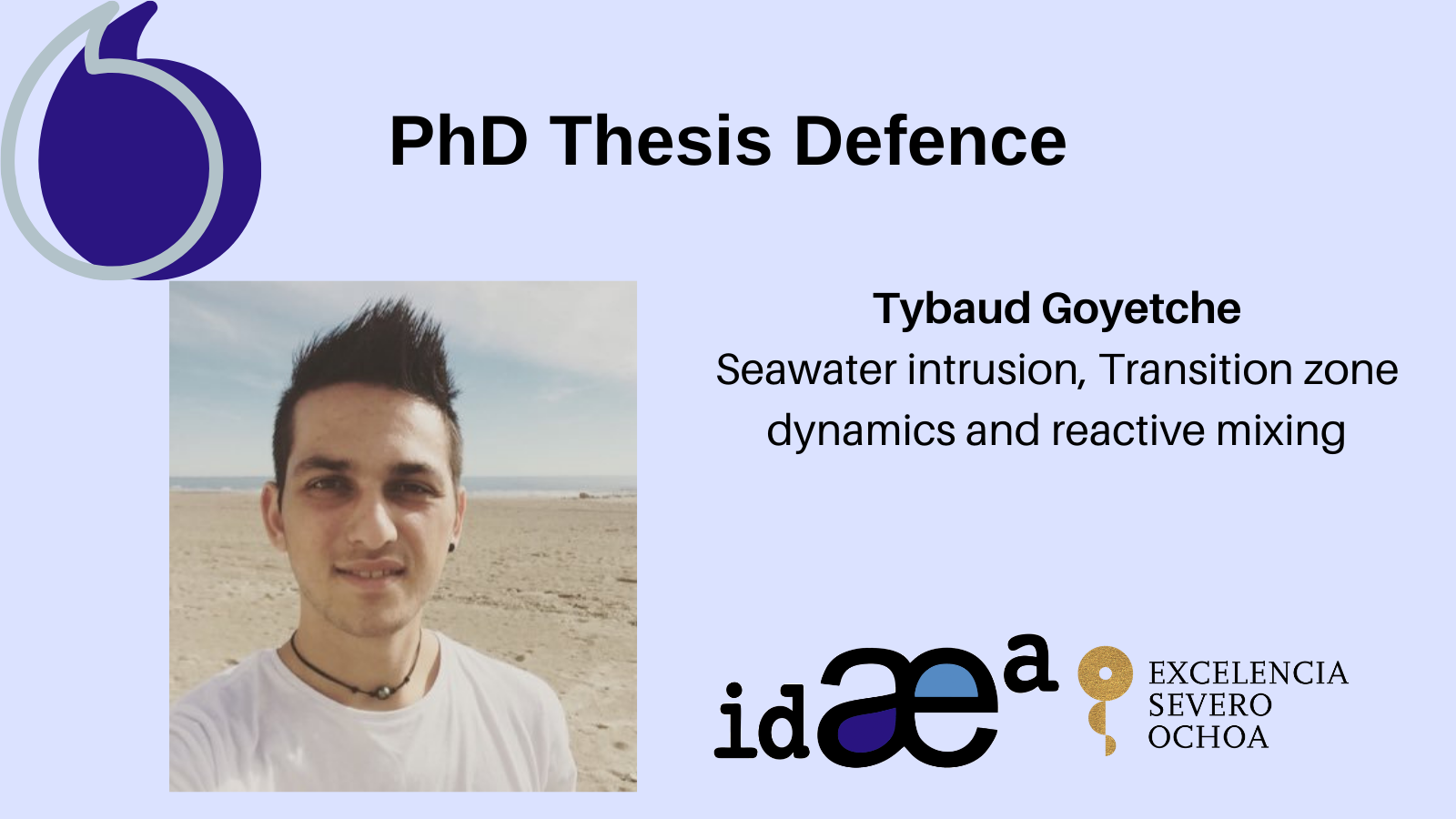
The PhD student Tybaud Goyetche will defend his thesis on seawater dynamics. Language of the event: English
The PhD student Tybaud Goyetche from the Groundwater and Hydrogeochemistry group, will defend his thesis next 19th July at 13:00h. If you want to attend, please click on this link.
Title: Seawater intrusion, Transition zone dynamics and reactive mixing
Directors: Jesús Carrera, Linda Luquot
Thesis Comittee: Mohsen M. Sherif, Anna Jurado Elices, Luis Guarracino, Gudrun Massmann and Daniel Fernandez Garcia
Abstract
Freshwater quality and availability in coastal areas are affected by seawater intrusion into coastal aquifers. While coastal water quality and coastal ecosystems can be significantly affected by pollutants discharged into the sea.
In this thesis we investigate: (i) the use of sea level periodic fluctuations (e.g. tides) to characterize coastal aquifers hydrodynamic parameters; (ii) the chemical reactions that occur in the mixing zone between freshwater and seawater; and (iii) the impact of high-frequency fluctuations (e.g. storms) on the mixing zone and chemical reactions. Thus, the Argentona experimental site allowed us to apply and validate the investigated methods.
The results show that thanks to the tidal method we have been able to clarify the technique and make its application easier. In addition, we make one of the first applications to a real aquifer where we detail the entire process from the acquisition and filtering of head data to finally obtain the hydrodynamic parameters by numerical modeling. This allowed refining the conceptual model and observing the pronounced impact of aquitard on the propagation of inland tidal fluctuations.
In addition, we have investigated the chemical reactions that occur by the mixing between freshwater and saltwater. The results show that coastal aquifers are a fairly complex system with many chemical reactions. We observe the predominance of cationic exchange reactions, but also quite a few redox reactions using organic matter as electron donors and molecules such as dissolved oxygen, nitrates, iron, or manganese oxides as electron acceptors. We have observed that quite a few reactions associated with the rocks that form the reservoir also occur. But we go beyond identifying them, we present a method to quantify these reactions, which allows us to observe the spatial distribution of the reactions. Furthermore, by quantifying them, it is possible to estimate the chemical composition of the water that is discharged into the sea. As a result, nutrients discharge to the sea can be estimated through the quantification of their degradation.
Finally, we investigated the impact of an intense rain event over a coastal aquifer and its mixing zone. We acknowledge a freshwater displacement occurs in the direction of the sea caused by the aquifer recharge. But we also observed how the interface is pushed inland during the recovery. These unique conditions can have a significant impact on the annual nutrients balance released to the sea. In fact, by moving the interface, the chemical conditions are modified and a significant impact on the chemical reactions is observed.