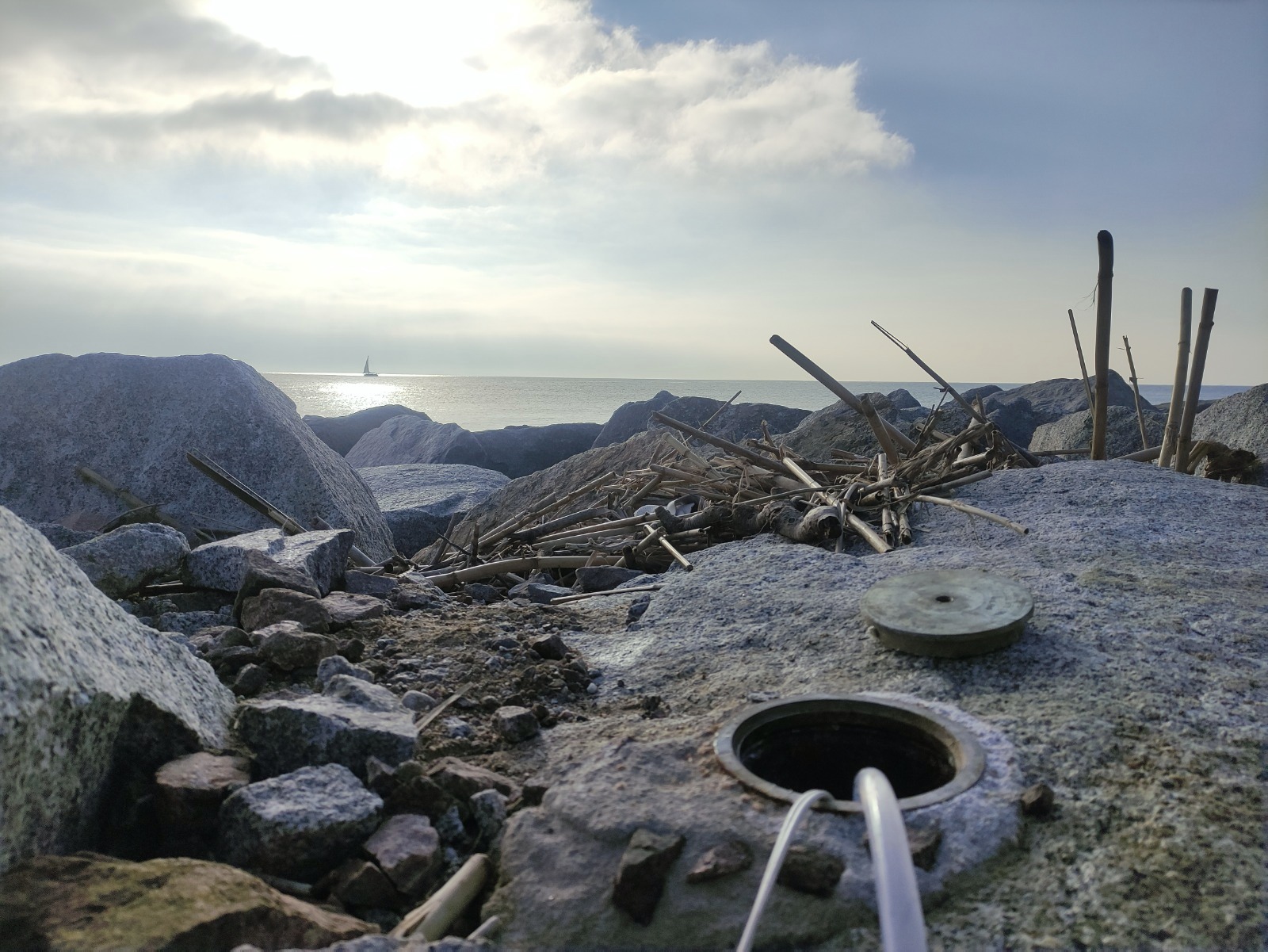

Some contaminants detected in the Argentona stream aquifer can serve as tracers to study the discharge of the aquifer into the Mediterranean Sea. Source: Daniel Gutierrez (IDAEA-CSIC)
The Institute for Environmental Assessment and Water Research (IDAEA-CSIC) and the Polytechnic University of Catalonia – BarcelonaTech (UPC) have carried out the most exhaustive analysis to date of chemicals of emerging concern in a coastal aquifer, in an experimental area located in the stream from Argentona, on the coast of Barcelona.
The study, published in the Journal of Hazardous Materials, has identified 92 emerging contaminants in the aquifer, of which 44 reach the Mediterranean Sea, although in lower concentrations, showing the great degrading power that aquifers have over various toxic compounds. The authors propose that some of these contaminants can serve as tracers to better understand the discharge process from the aquifer to the sea, which would help to better manage this water resource.
“Coastal aquifers are very difficult systems to study at the hydrogeological level. In our case, the aquifer was very well characterized, which allowed us to apply high-resolution techniques to detect the presence and transport of chemicals of emerging concern”, indicates IDAEA-CSIC researcher Pablo Gago-Ferrero, lead author of the study.
Nota de prensa (ESP)
Nota de premsa (CAT)
Daniel Gutiérrez-Martín, Rubén Gil-Solsona, Maarten W. Saaltink, Valentí Rodellas, Rebeca López-Serna, Albert Folch, Jesús Carrera, Pablo Gago-Ferrero. Chemicals of emerging concern in coastal aquifers: Assessment along the land-ocean interface. Journal of Hazardous Materials, 448, 2023, 130876. DOI: 10.1016/j.jhazmat.2023.130876