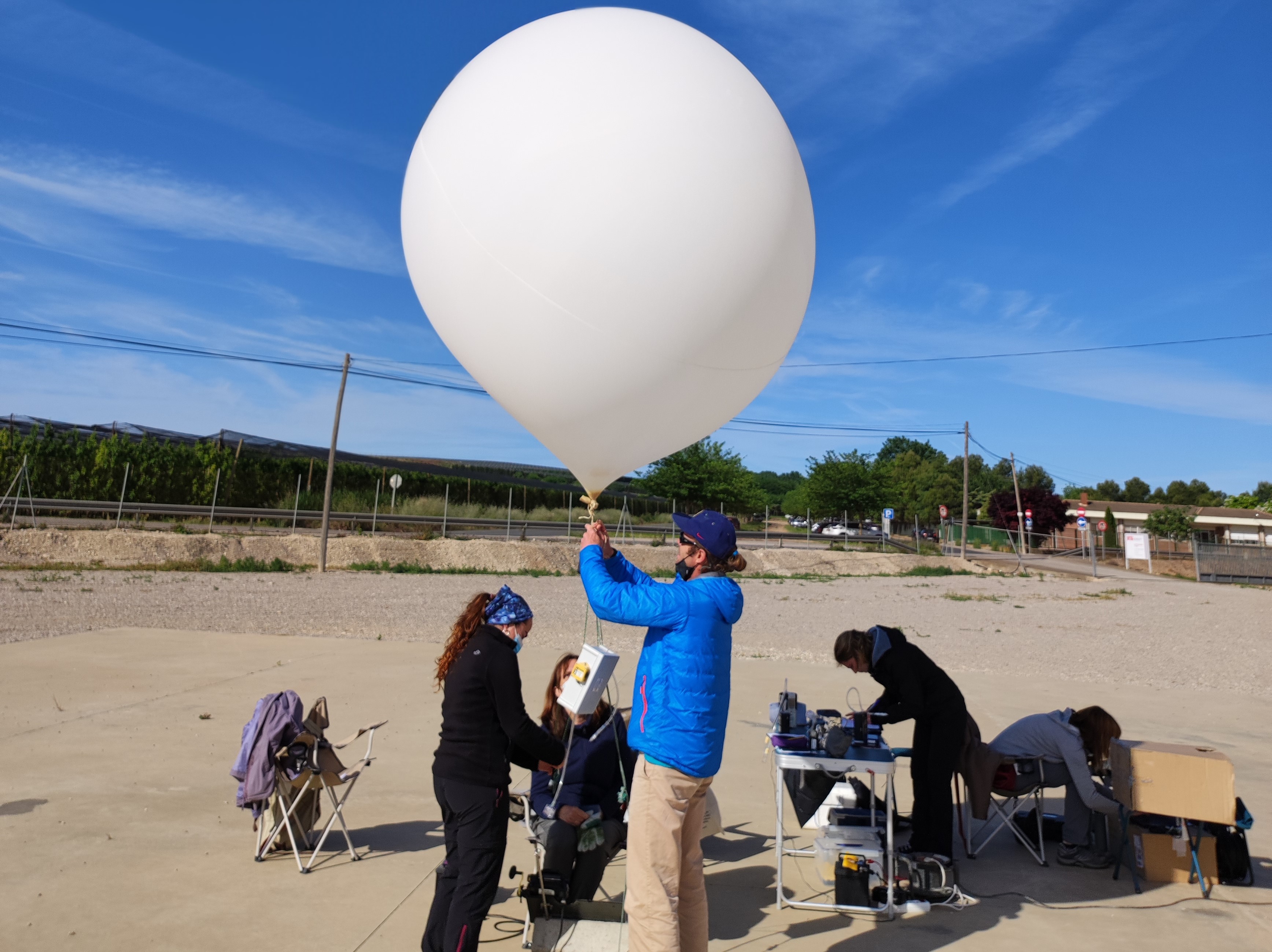

The IDAEA-CSIC scientific team prepares the hot air balloon to analyse organic aerosols. Source: Joan O. Grimalt
A study by Clara Jaén, Barend L. van Drooge, and Joan O. Grimalt, from the Geochemistry & Pollution group, has identified the emission sources of the most harmful organic pollutants present in atmospheric aerosols in different areas of Catalonia.
The results show that, in urban areas, traffic is still the main source of these aerosols. However, in rural areas, these aerosols come mainly from burning biomass, especially when it is cold. Actually, these aerosols coming from biomass burning cause more damage to human cells than those generated by the traffic in Barcelona.
“Our work shows that, during the winter, towns can have much worse air quality than in Barcelona,” says Joan Grimalt, author of the study.
Poor burning of wood, stubble and other vegetable fuels, together with air stagnation, generate a large amount of toxic aerosols.
“The levels of toxic composts, such as benzo[a]pirè and other polycyclic aromatic hydrocarbons, are in in these cases 10 times higher in towns than in Barcelona”, explains Barend van Drooge, author of the study.
Researchers also used a helium air balloon to analyse the vertical distribution of pollution when the atmospheric air becomes stagnant. This occurs due to a temperature inversion: a layer of warm air is formed in the atmosphere at a certain distance from the surface, which means that the colder polluted air is ‘trapped’ at ground level.
Nota de prensa (ESP)
Nota de premsa (CAT)
Clara Jaén, Paula Villasclaras, Pilar Fernández, Joan O. Grimalt, Mireia Udina, Carmen Bedia, Barend L. van Drooge. Source Apportionment and Toxicity of PM in Urban, Sub-Urban, and Rural Air Quality Network Stations in Catalonia. Atmosphere, 2, 744 (2021). DOI: 10.3390/atmos12060744
Clara Jaen, Barend van Drooge, Joan O. Grimalt. L’aerosol orgànic a Catalunya. Fonts d’emissió i toxicitat. Revista de la Societat Catalana de Química, núm. 21 (2022), p. 38-48. DOI: 10.2436/20.2003.01.133