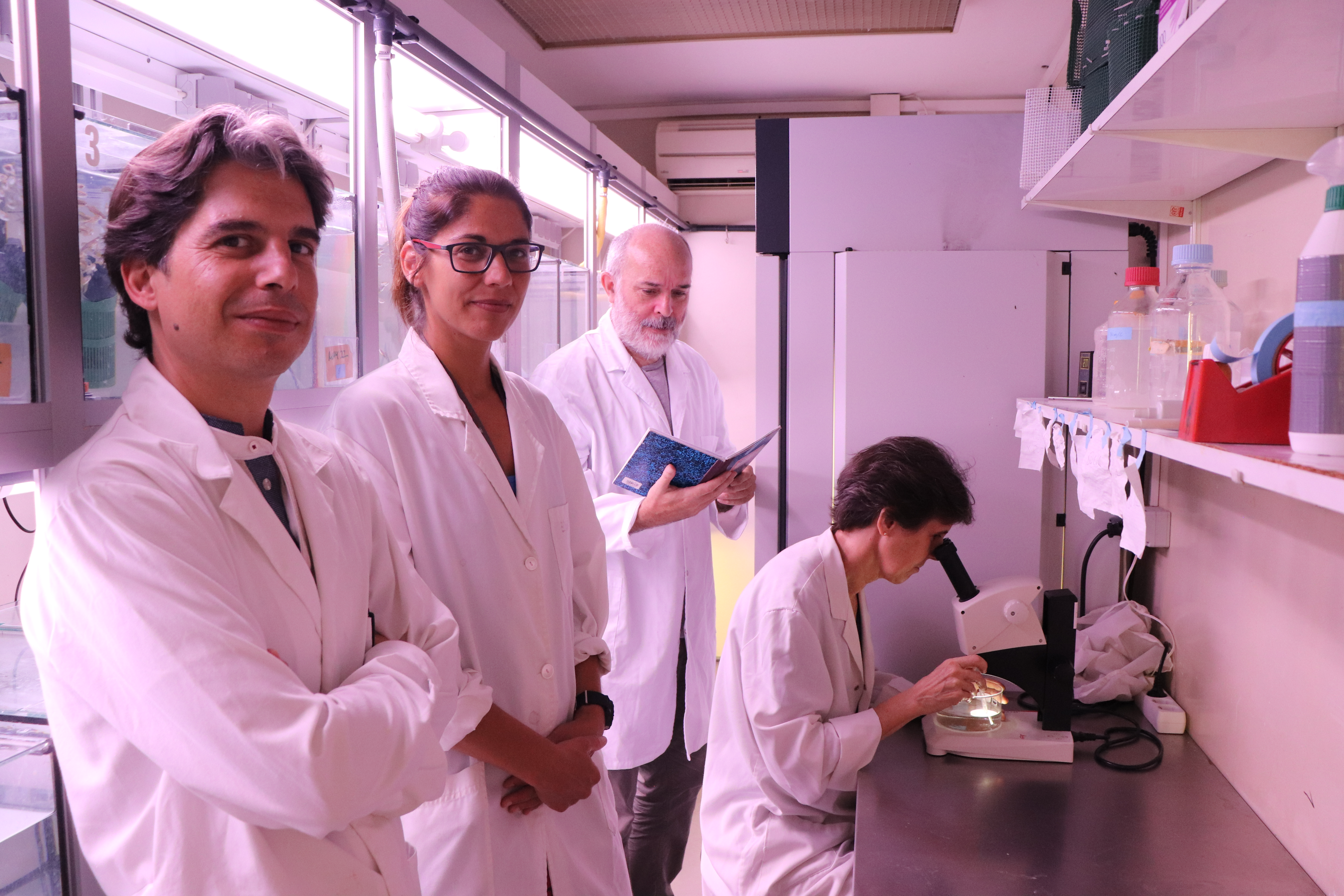

From left to right: Xavier Rovira (IQAC), Melissa Faria (IDAEA), Demetrio Raldúa (IDAEA), and Eva Prats (CID), in the zebrafish facility.
Researchers at the Institute for Advanced Chemistry of Catalonia (IQAC), in collaboration with the Environmental Toxicology group, from the Institute of Environmental Assessment and Water Research (IDAEA), have developed molecules that allow the control of the activity of beta-adrenoceptors located in cardiomyocytes, heart muscle cells, by the use of light.
This research, published in the Angewandte Chemie International Edition journal and tested in the zebrafish animal model, shows the potential of photopharmacology (drugs controlled by light) for the study and control of cardiac physiology, and its applicability in living beings. Besides, the results of this work point to the generation of future more precise therapies with
reduced side effects.
“This study confirms the enormous potential of zebrafish as a vertebrate model in cardiac photopharmacology studies,” says Demetrio Raldúa, from the Environmental Toxicology group, and author of this study.
Nota de prensa (ESP)
Nota de premsa (CAT)
Press release (ENG)
Anna Duran-Corbera, Melissa Faria, Yuanyuan Ma, Eva Prats, André Dias, Juanlo Catena, Karen L. Martinez, Demetrio Raldua, Amadeu Llebaria, Xavier Rovira. A Photoswitchable Ligand Targering the β1-Adrenoceptor Enables Light-Control of the Cardiac Rhythm. Angewandte Chemie. Int. Ed. DOI: 10.1002/anie.202203449