

Katerina Savva receiving her award for the best poster presentation at SETAC Copenhagen.
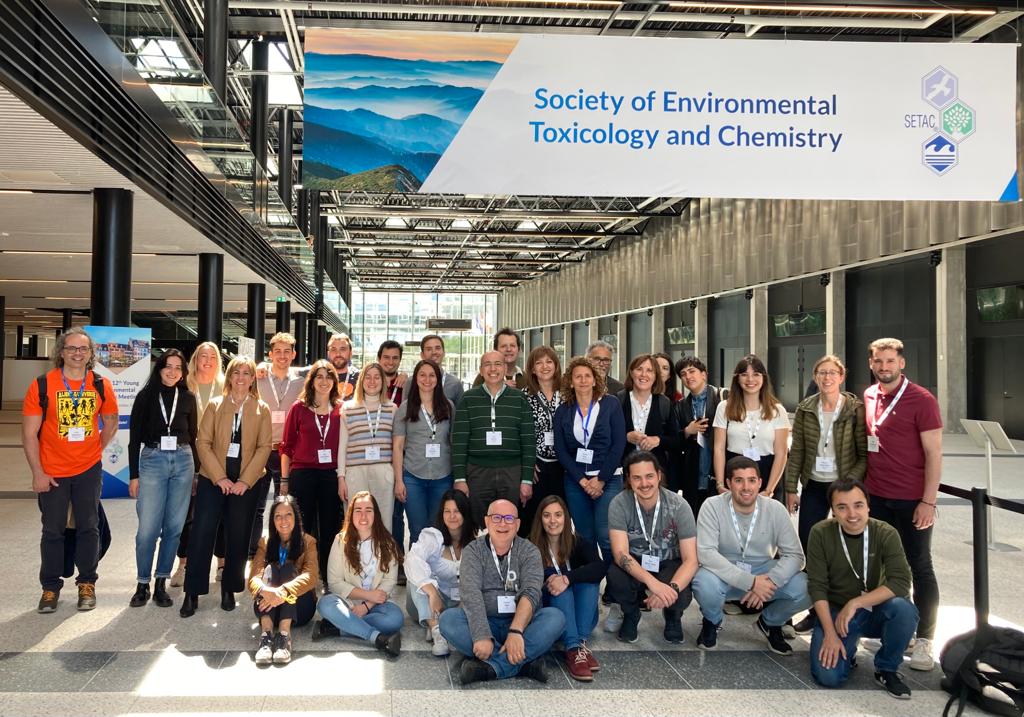
IDAEA researchers from the Environmental Chemistry Department attended the SETAC Europe 32nd annual meeting, celebrated in Copenhagen on May 15-19, 2022. The conference, organized by the Society of Environmental Toxicology and Chemistry (SETAC), is the reference event for European researchers studying the impacts of stressors, chemicals, and technology on the environment. It is also an open forum for scientists and institutions engaged in the study of environmental problems, management and regulation of natural resources, education, research and development, and manufacturing.
The researcher Katerina Savva, from the ON HEALTH group, was awarded the best poster presentation. She presented her results on screening and quantification of plastic additives in single-use household items and cytotoxic effects in two cell lines.
The principal investigators from the ON HEALTH group (Ethel Eljarrat, Marinel·la Farré, Marta Llorca, and Sandra Pérez) chaired the session on methodologies for the bio-monitoring of organic pollutants and their metabolites. Carmen Bedia, from the Chemometrics group, and Barend van Drooge, from the Environmental Toxicology group, were chairs of the session “Air pollution: effects on human and environmental health“.

From left to right: Marta Casado, Marinel·la Farré, Ethel Eljarrat, Sandra Pérez, Carmen Bedia and Barend van Drooge as chairs of two different sessions.
The PhD researcher Aleix Balash, from the ON HEALTH group, gave an oral presentation on alternative methods to assess the exposure to pollutants using silicone wristbands and cotton T-shirts. Diana Manjarrés, PhD researcher in the same group, showed her results on the organic pollutant sampling with invasive species. Other researchers, such as Laia Navarro, Julio Fernández, Claudia Sanz, and Núria Trilla, presented their work in poster formats.

From left to right: Aleix Balash and Diana Manjarrés showed their results in oral presentations.

From left to right: Laia Navarro, Julio Fernández, Claudia Sanz and Núria Trilla during their poster presentations.
The conference was also an opportunity for IDAEA researchers to meet and discuss future environmental actions that could be implemented at the institute.