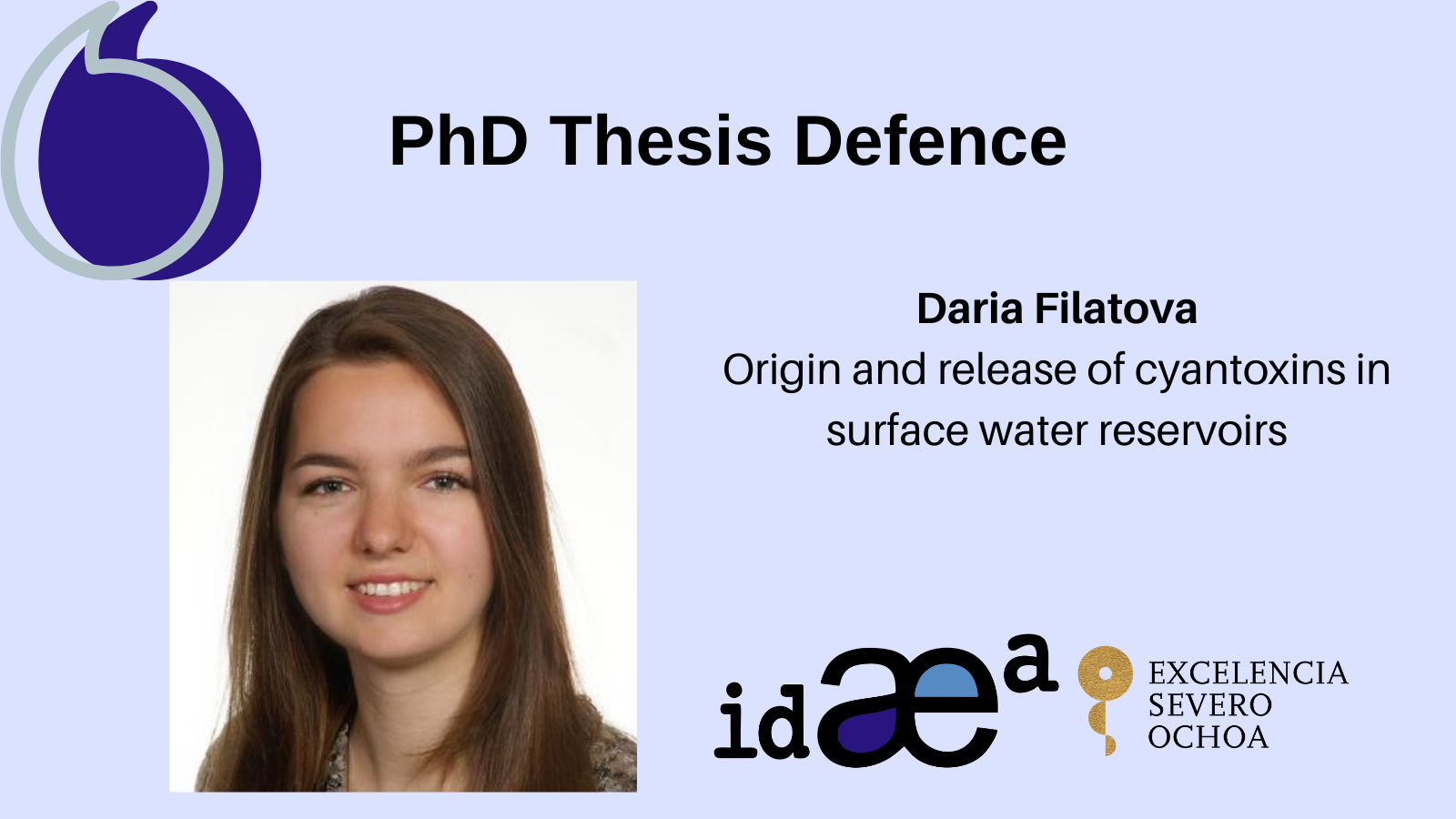
The PhD student Daria Filatova will defend her thesis on cyantoxins in surface water reservoirs Language of the event: English
The PhD student Daria Filatova from the ENFOCHEM group, will defend her thesis next 20th July at 11:00h. If you want to attend, please write a registration request to this email vd.quimica.recerca@ub.edu, and they will provide all the details.
Title: Origin and release of cyantoxins in surface water reservoirs
Directors: Marinella Farré, Óscar Núñez
Thesis Committee: Mercè Granados, Begoña Espiña and Bjarne W. Strobel.
Abstract
Cyanobacteria are prokaryotes and components of regular periphyton formation. Overall, there are around 2000 cyanobacterial species that live in various environments. Some cyanobacterial species are known to form blooms, which can cause harmful effects when blooms’ intensity is high. Abundant blooms can deplete oxygen causing hypoxic conditions that may result in the death of plants and animals. Another major issue associated with bloom-forming cyanobacteria is the production of bioactive secondary metabolites, some of which are known to be toxic. One of the main routes of human exposure to cyanobacterial toxins occurs through water, both drinking and recreational water use. There are two main drivers that favour cyanobacteria bloom: nutrient over-enrichment and on-going climate change. Nowadays, little quantitative information is available on temporal variations of cyanotoxins, including the European region. Establishing seasonal trends of cyanobacterial toxins will promote the development of effective water management strategies.
Cyanotoxins can be divided into two main groups according to their targeted tissue/organ of toxicity: hepatotoxins and neurotoxins. Main cyanobacterial hepatotoxins are microcystins, nodularins, and cylindrospermopsin, while anatoxin-a, and saxitoxin are the main neurotoxins. Owning to posed toxicological risks by various cyanobacterial metabolites, guidelines values in drinking water have been introduced by several countries. What is more, the update of the WHO guideline has been recently finalized, and now it involves threshold values not only for microcystin variant, but also for cylindrospermopsin, anatoxin-a, and saxitoxins. The assessment of the occurrence and the risks of the exposure to cyanotoxins require robust, straightforward, and sensitive analytical methodologies for their identification and quantitation in the aquatic environment, and particularly in drinking water reservoirs. Besides, to perform extensive monitoring studies, these methods should be cost-effective and rapid.
Beyond these cyanotoxins, cyanobacteria can produce a variety of other bioactive secondary metabolites, including cyanopeptides. These compounds belong to several classes including cyanopeptolins, anabaenopeptins, aeruginosins, aerucyclamides, and microginins. Some of these compounds are known to be co-produced together with other cyanobacterial toxins. Compounds from these classes have shown acute toxicity in planktonic grazers and are able to inhibit various enzymes. However, there is a knowledge gap in both their occurrence and posed toxicological risks.
In the framework of this thesis, several points were addressed in order to fulfil the current gaps of the research in the area of occurrence of cyanobacterial toxins ant other metabolites in surface water. Literature review on current analytical approaches for analysis of cyanotoxins and their seasonal variations in previously conducted studies in European region was carried out. Main analytical approaches were compared, what provided solid background for analytical method development. Based on available seasonal studies on cyanotoxins in different European climate zones, patterns for continental, Mediterranean, and oceanic climate zones were described.
A method for the assessment of multiclass cyanotoxins in freshwater based on dual solid-phase extraction liquid chromatography coupled with high-resolution mass spectrometry was developed, optimised, and validated. The developed method showed high sensitivity, selectivity, and robustness. The application of an ultra-high pressure liquid chromatography column allowed fast separation, what makes this method more cost-effective.
A targeted method was applied for the analysis of freshwater samples from Spain, Switzerland, and the United Kingdom. Several targeted cyanotoxins were identified and quantified. Additionally, mass spectrometry data acquired in high resolution provided an opportunity of posterior suspect screening, which revealed potential presence of another cyanopeptide – anabaenopeptin.
Additionally, the targeted methodology was expanded for an application of suspect screening for a wide range of cyanopeptides. This method was applied for the analysis of raw drinking water from the United Kingdom. Suspect screening revealed co-occurrence of targeted compounds together with other cyanopeptides. The obtained results are the first to present concentrations of anabaenopeptins, cyanopeptolins, aeruginosins, and microginins, along with microcystins, in the reservoirs of the United Kingdom.