Carbon capture and storage in deep geological formations is a reliable strategy to mitigate climate change. It consists of capturing CO2 from large point sources or the atmosphere and injecting it into suitable deep formations, such as saline aquifers, depleted oil and gas reservoirs, coal beds, and salt domes. When this CO2 is injected into the underground to be stored, it dissolves in the existing water of the rocks and produces an acidic solution like soda. This acidic solution can chemically react with rock and dissolve it, hence, imposing uncertainties in the long-term fate of the injected CO2. For this reason, chemical reactions between CO2 and underground rocks need to be thoroughly understood.

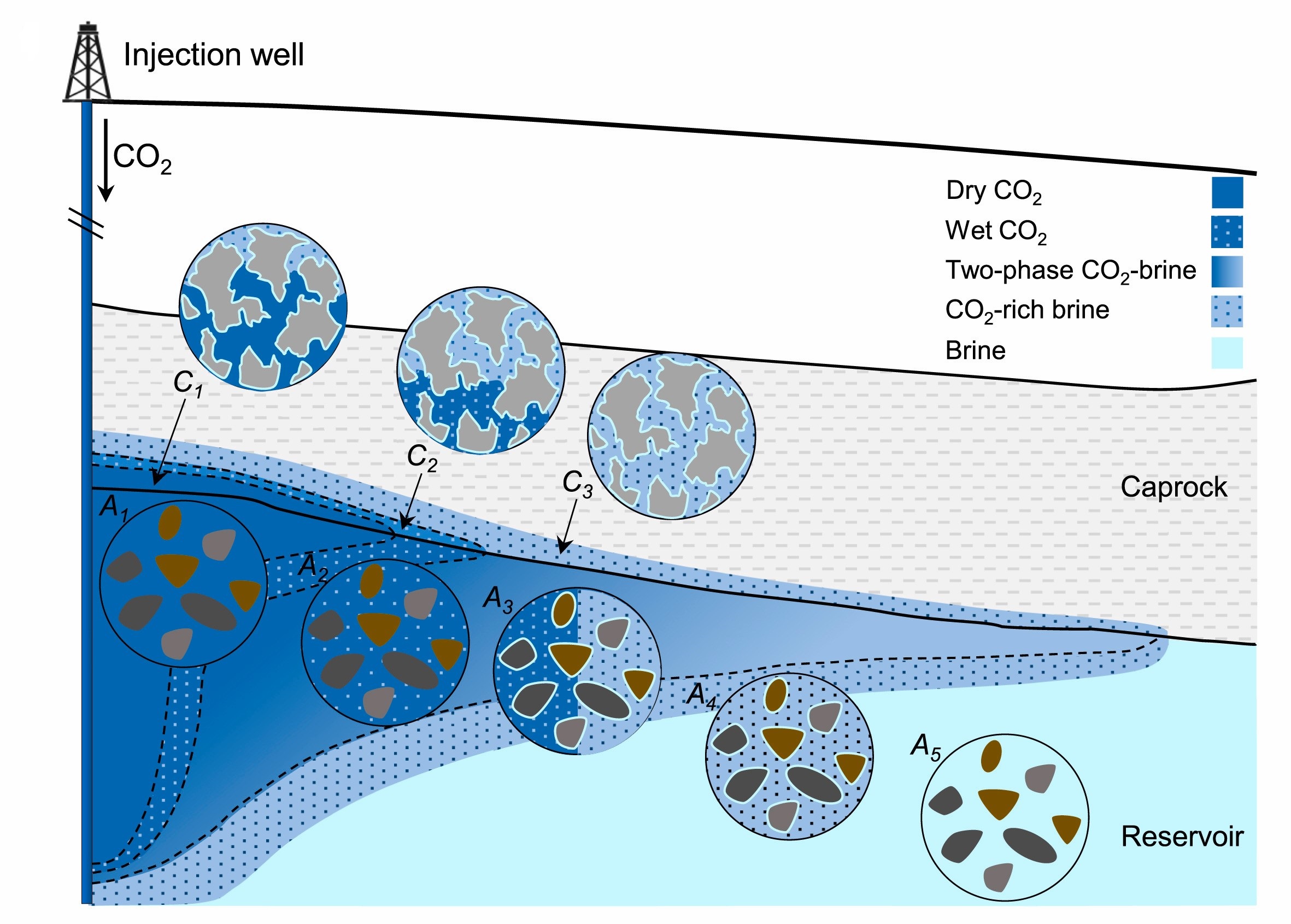
Schematic of a geological CO2 storage site with zones formed around the injection well. A1 to A4 represent zones formed in the reservoir rock. The caprock is divided into 3 zones: two-phase CO2-brine zones (dry CO2 in C1 and wet CO2 in C2) and a CO2-rich brine zone (C3). | Source: Vafaie A. et al. 2023
A group of researchers from the IDAEA-CSIC and IMEDEA-CSIC have conducted a comprehensive review of the present knowledge of chemical, hydraulic, and mechanical processes involved in CO2 injection that has been acquired from laboratory experiments using both intact and fractured rock samples.
“The main output of this review is that chemical reactions induced by CO2 injection are unlikely to endanger the safety of CO2 storage“, claims Atefeh Vafaie, IDAEA researcher and first author of this work.
Published in Renewable and Sustainable Energy Reviews, the work shows that the experiments alone cannot capture the complex dynamics of CO2 flow underground, but they provide critical insights into the short-term alterations of rock with implications for geologic CO2 storage. The authors argue that studying naturally altered rocks, extending the experiments to tens-of-meters-scale underground rock laboratories, and bringing together experimental observations and numerical simulations are valuable to better understand the chemo-hydro-mechanical processes and to upscale them across space and time.
Atefeh Vafaie, Jordi Cama, Josep M. Soler, Iman R. Kivi, Victor Vilarrasa. Chemo-hydro-mechanical effects of CO2 injection on reservoir and seal rocks: A review on laboratory experiments. Renewable and Sustainable Energy Reviews, 178: 113270. DOI: 10.1016/j.rser.2023.113270