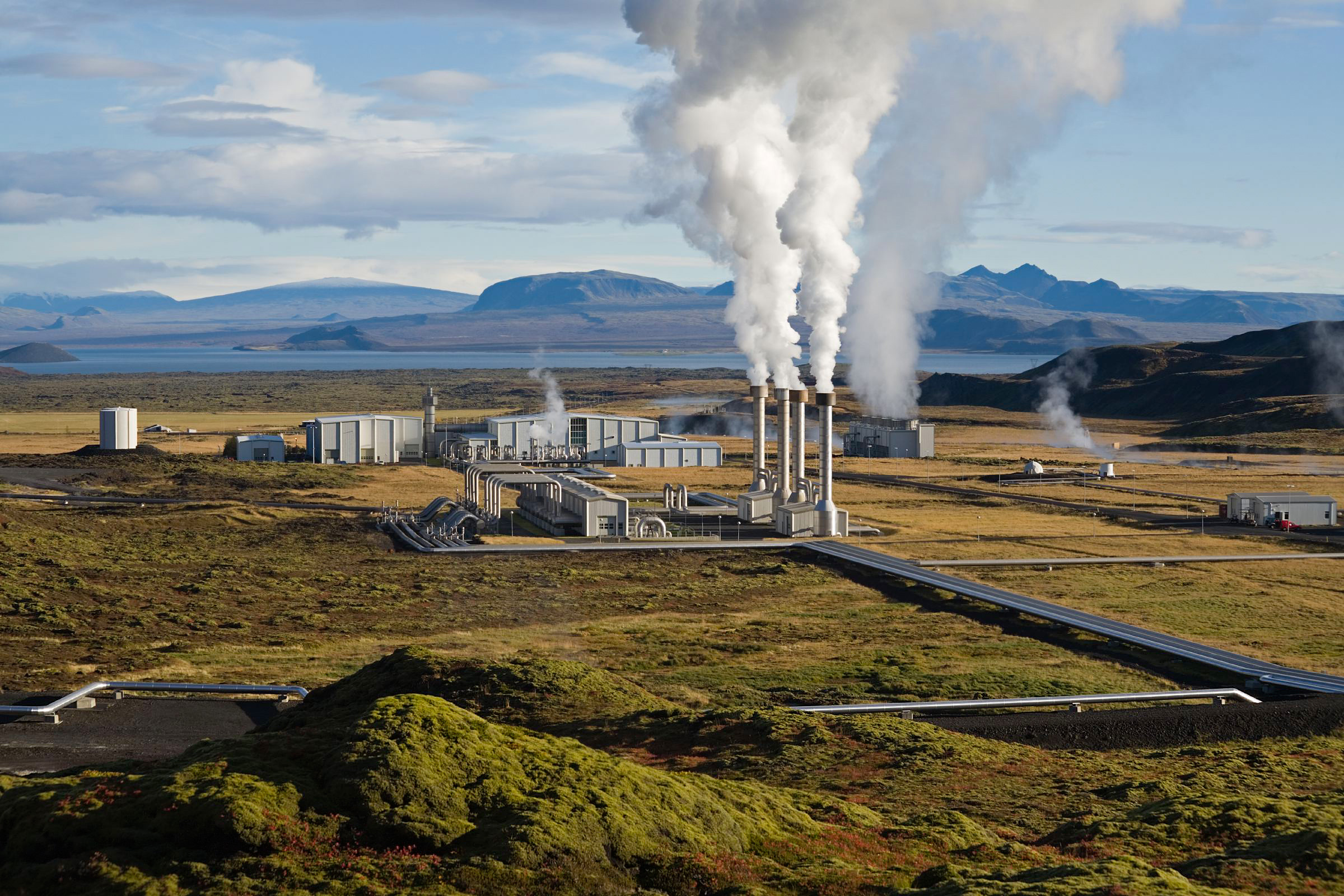

Geothermal plant in Nesjavellir (Iceland). Source: Wikimedia.
A study led by the Mediterranean Institute for Advanced Studies (IMEDEA-CSIC-UIB), in collaboration with the Institute of Environmental Assessment and Water Research (IDAEA-CSIC) and the University of Colorado, and published in Nature Communications Earth & Environment, has identified the causes of the seismicity that occurred in Basel (Switzerland) in 2006, from an Enhanced Geothermal System (EGS) plant. This technology consists of drilling into the earth’s crust to use the heat at great depth to produce renewable energy.
The scientific team has developed a numerical tool that makes it possible to reproduce the reactivation of the faults that occurred in the EGS in Basel, in response to the hydraulic stimulation in the injection well. This paves the way to develop methodologies that allow geothermal energy to be used safely and cleanly to produce electricity continuously 24 hours a day, seven days a week, with zero CO2 emissions.
However, the hydraulic stimulation can generate setbacks. According to IDAEA researcher Silvia De Simone, “the sliding of the fractures generates microseisms. The disconcerting thing is that once pressurized water is no longer injected, seism of magnitude greater than those occurred during the injection are frequently produced, generating earthquakes that are felt on the surface and can cause damage, such as what happened in Basel or in Pohang (South Korea). This phenomenon goes against logic, which would suggest that once the injection stops, the pressure decreases and the stability of the faults should increase”.
Boyet, A., De Simone, S., Ge, S. et al. Poroelastic stress relaxation, slip stress transfer, and friction weakening controlled post-injection seismicity at the Basel Enhanced Geothermal System. Commun Earth Environ 4, 104 (2023). DOI: 10.1038/s43247-023-00764-y